
Tag Archive for: location

Bank Branch Closures and What They Mean for ATM Owners

Bank branch closures have been accelerating across the United States for decades. The trend continued last year as banks in the U.S. closed hundreds more branches than they opened. Banks are consolidating physical locations at a rapid pace because of rising operational costs, shifts toward digital banking, and changes in consumer behavior. While bank branch closures create certain challenges for some communities, it also presents opportunities for ATM owners.

Understanding how branch closures affect cash access, transaction volume, and placement strategy is critical for anyone operating or considering investing in ATMs. Here is why banks are closing and how it might affect you as an ATM owner.

Why Bank Branches Are Closing

Several factors contribute to widespread bank branch closures. First is the overwhelming shift to digital banking. Because consumers can use mobile apps, online bill pay services, and remote check depositing, foot traffic to banks has significantly decreased. 

Furthermore, maintaining brick-and-mortar locations is expensive, especially in low-traffic or rural areas. Therefore, branches struggling to cover these expenses are forced to close; others may close simply to reduce operating costs. 

It becomes more difficult for branches to justify high operating costs when foot traffic declines. Accelerated by the pandemic, customer habits have changed in recent years. Consumers have become accustomed to and increasingly prefer self-service and on-demand access to banking services over in-branch visits.

While banks may see closures as a way to improve efficiency, the impact on local cash access is significant and detrimental especially to low-income and rural areas.

Reduced Cash Access Creates Demand for ATMs

When a branch closes, customers often lose access to important banking services like teller withdrawals and in-branch ATMs. For independent ATM owners, then, this gap creates new demand, particularly in areas where the next closest branch is several miles away and public transportation is limited.

Bank branch closures are most common in low-income and rural areas. These populations rely heavily on cash as many residents are likely underbanked. In these cases, an independently owned ATM becomes the primary cash access point for an entire neighborhood.

Increased Transaction Volume Opportunities

As an ATM owner/operator, it’s important to understand how bank branch closures affect ATM usage as well. Keep in mind that ATMs in neighborhoods that have experienced bank branch closures will see higher ATM withdrawal frequencies and larger average withdrawal amounts. Therefore, surcharge fees may increase due to limited alternatives.  

ATM owners who strategically place machines in locations near closed branches often see a noticeable increase in transaction volume within months. So how can ATM owners intentionally target these locations?

How to Identify Post-Closure ATM Opportunities

Identifying the best opportunities after bank branch closures requires more than noticing an empty building. Successful ATM owners combine local awareness with data-driven decisions and strategic partnerships to determine where demand will actually materialize.

Branch Closure Tracking and Market Intelligence

One of the most effective strategies is actively tracking announced and recent bank branch closures. Public regulatory filings, bank press releases, and local news often reveal closures months before they occur. Furthermore, the FDIC requires that banks notify customers at least 90 days before closing and post signs at the branch 30 days prior. This advance notice gives ATM owners time to evaluate surrounding neighborhoods and secure placement agreements before competitors move in.

Owners who consistently monitor closure data can spot patterns—such as clusters of closures in suburban or rural markets—that indicate sustained, long-term demand rather than temporary disruption.

Demographic and Cash-Usage Analysis

Not all areas affected by branch closures will generate strong ATM performance. Insight into local demographics helps ATM owners focus on markets where cash use remains high. Census data, consumer spending reports, and local economic development resources can help confirm whether a closed-branch area is likely to support consistent ATM usage.

Specifically, there might be greater demand in areas with a high concentration of hourly workers or tipped employees. Neighborhoods with limited access to alternative financial services can also benefit from independent ATM services. And, communities with older populations or lower smartphone adoption might rely more on ATMs.

ATM and Banking Location Mapping

Mapping tools are critical for visualizing cash-access gaps. By plotting former bank branches alongside existing ATMs and remaining financial institutions, ATM owners can identify “cash-” or “banking deserts” where demand is likely to concentrate.

These tools also help assess distance to the nearest bank or credit union, walkability and foot traffic, and competitive ATM density and surcharge ranges. A location that looks marginal on paper may become highly attractive once nearby branch access disappears.

Local Business Partnerships

Retailers located near closed branches often experience an increase in cash-related customer requests. Proactively approaching convenience stores, grocery stores, bars, and service-based businesses in these areas can lead to mutually beneficial placement agreements.

For ATM owners, these partnerships offer built-in foot traffic from displaced bank customers, shared interest in keeping customers on-site longer, and opportunities for lower placement costs in exchange for revenue sharing.

Business owners frequently welcome ATMs as a way to offset card processing fees and capture sales that might otherwise go elsewhere.

Performance Monitoring and Rapid Deployment

Finally, ATM owners who already operate machines nearby can use transaction data to spot early signals of increased demand. Rising withdrawal frequency or larger average withdrawals often indicate that a branch closure is pushing users toward alternative access points.

Operators who can quickly redeploy machines or install additional units in response to these trends are best positioned to capitalize on post-closure demand before the market becomes saturated.

Challenges for ATM Owners Under Heavy Transaction Loads

ATM owners who are able to serve communities that have experienced bank branch closures might see higher usage, but that also increases the operational workload. Higher usage means more frequent cash replenishment. And there is more at stake if machines go offline or experience downtime for any reason.

When serving “banking deserts,” there is a greater importance placed on monitoring, maintenance, and fraud prevention. ATM owners must ensure their infrastructure can scale with increased demand, especially in areas where customers have few alternatives.

Finally, ATM owners should be sensitive to community considerations when setting surcharge fees, balancing profitability with community impact. Excessive surcharges can create backlash in underserved areas while transparent pricing builds trust and repeat usage. 

The Long-Term Outlook for ATM Owners

Bank branch closures are reshaping how consumers access cash. For ATM owners, these changes present a rare combination of increased demand and strategic opportunity, provided operators are thoughtful about placement, pricing, and reliability.

Despite hints to a cashless future, bank branch closures suggest the opposite reality for many communities: cash is still essential, but access points are shrinking.

For ATM owners, this means that ATMs remain relevant in the financial ecosystem. There are strong opportunities in underserved and transitional markets. And there is a greater need for smarter placement, reliable uptime, and community-aware pricing.

In communities affected by branch closures, ATM owners often become a critical financial access point rather than just a convenience service. So ATM owners should do their research and offer services and surcharges that really serve their communities.

As banks pull back from physical locations, independent ATM owners are increasingly stepping forward as the backbone of everyday cash access. But not every closed branch location translates into a profitable ATM opportunity. Smart placement depends on a variety of factors. Therefore, data-driven placement decisions are becoming a key differentiator for successful ATM operators.

Think you’ve identified an area that could benefit from independent ATM service? Contact us today to get started!
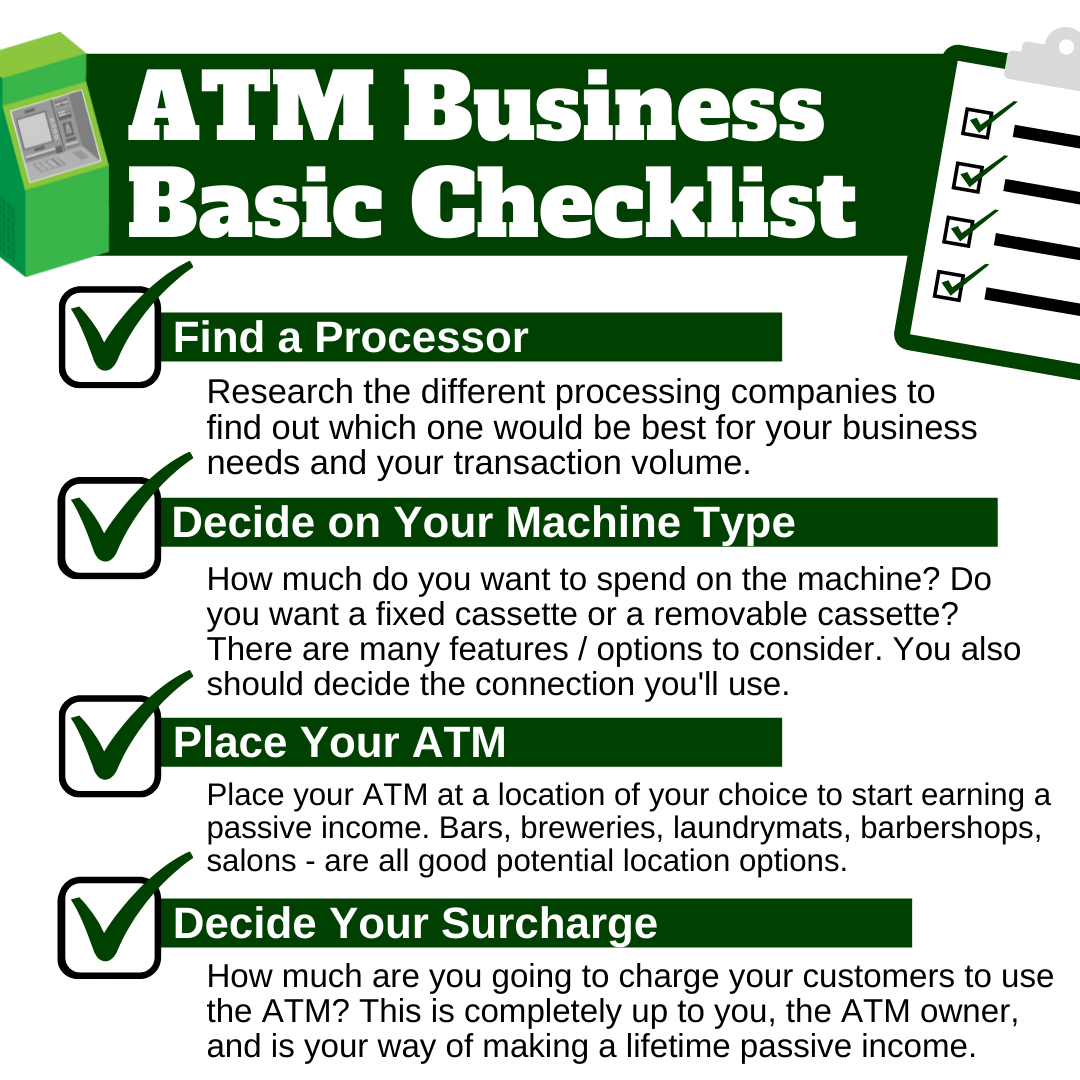
How to Complete Your ATM Business Basic Checklist

This ATM business basic checklist is for you to use as you go through the process of operating an ATM machine. If you’re looking for more of a step-by-step guide, check out our article How to Start an ATM Business in 5 Steps

However, if you are looking for a list of what needs to be done, this is it. Once you have completed each item in this ATM business basic checklist, you will officially be in business. You can’t neglect any of these items if you want to start operating your own ATM machines!

1. How to Find a Processor

What is ATM Processing?

You need to work with an ATM processing company so that your ATM machine can communicate with your customers’ banks. An ATM processor identifies the network of each card inserted into your ATM machine, routes the information to the user’s bank, verifies the funds, then receives approval from the bank to dispense the withdrawal amount up to what’s available in the account. Check out our video here for more information.

Factors to Consider

Although ATM processing is pretty basic, there are a number of factors to consider when choosing an ATM processing company. It is in your best interest to research a variety of companies to find the one that is going to best suit your business needs and transaction volume.

Now, if you’re just getting started, you might not know your transaction volume yet. But your processor might. Find an experienced company that will be able to assist you throughout your entire career as an ATM owner. 

Experience

An experienced company will be able to give you advice regarding the location you choose (keep reading this ATM business basic checklist for more information on choosing a location) as well as how much you can expect to make from that location or from alternative locations.

Support

You also want to work with an ATM processing company that wants you to make money. A company that acts as a business partner will offer you support throughout your entire career, not just during the initial setup. The company should offer training, ongoing support, and dependable support (meaning they answer the phone when you call…).

Other Services

Finally, you want to know what additional services the company provides. Not all ATM machines work with all processing companies, so if you choose a processor before your equipment, you might want to know if they also sell equipment. Because they will only sell machines that they can support.

If you purchase your equipment before choosing a processing company, you will have to make sure the company can support it. (More on deciding machine type next.) And you can switch processors after you are already in operation. Your needs might change, or you might not get the service you expect from your current processing company. In these cases, you will need to switch to a company that can support the machines you already have. 

Other services you might want to consider are vaulting, remote monitoring, and automated payments. This business is all about building passive income. So you want to minimize your workload as much as possible.

You can load your ATM machine (vaulting) yourself to make as much profit as you can. But if this isn’t convenient for you, your ATM processing company might offer this service. 

Remote monitoring allows you to track your machine’s activity and cash availability which makes it easier for you to keep it stocked and minimize downtime. And automated payments prevent you from having to spend time making transfers yourself and constantly online banking. The less time you spend managing your ATM, the more passive income you make.

When looking for an ATM processor, look for a business partner. Find out more about how to choose an ATM processor here.

2. How to Decide on Your Machine Type

You have lots of options when it comes to choosing ATM equipment. If you’ve already chosen an ATM processing company to work with, you will have to narrow your search to machines the company can support. If the company sells machines, this might be the simplest item on this ATM business basic checklist!

Machine Type

First, you need to decide if you want a freestanding machine, a through-the-wall (TTW) machine, or a wall mount machine. The three most important factors to consider when it comes to machine type are cost, space, and security.

TTW machines are the largest of the three types and therefore cost a little more. However, they are more secure because the vault extends into another room that can be secured during regular operation and vaulting. Unfortunately, they require a lot of space and some construction work to allow the machine to fit into the wall if the space doesn’t already exist.

Freestanding machines are smaller than TTW and are therefore a little cheaper. You also have more flexibility with the placement of a freestanding machine. Likely, a majority of the ATM machines you see day to day are freestanding.

Wall mount machines are the smallest of the three types. They are also the cheapest, but they don’t hold as much cash. Wall mount machines are a good option for slower locations. Despite the name, this type can be mounted to a countertop as well which makes them easy and convenient to place; they don’t take up a lot of space.

Manufacturers

Some of the biggest names in ATM equipment are Hyosung, Genmega, Hantle, and Triton. All are reputable companies that have been in the business for a long time and are known for producing quality equipment. 

Check out our ATM Buyers Guide for more guidance on choosing the ATM equipment that’s best for your business. We also compare Hyosung and Genmega, the two top of the line ATM manufacturers.

New vs. Refurbished

Finally, you have to weigh the pros and cons of a new vs. refurbished machine. It really comes down to your budget, your experience, and machine availability. 

We recommend starting with a new ATM machine at least for your first one. Newer models come with improved features and advanced technology making them easier to operate.

However, refurbished ATMs are also good options. It just depends on what is available and the quality of the refurbishment. If you have your heart set on a specific manufacturer or model, you might not be able to easily find what you’re looking for; you will more likely have to choose from what’s available. 

Most importantly, make sure you purchase certified refurbished if you choose to go this route. This guarantees that the machine has had standards checks, detailing, and upgrades applied.

3. How to Place Your ATM

If you own your own store, you can go ahead and mark this off of your ATM business basic checklist! If you plan to place your machine in someone else’s business or store, consider these factors:

  • Foot traffic
  • Proximity to other ATMs
  • Proximity to you
  • Liquor license

The busier the location is, the better the location’s reviews are, the more people that pass by it every day, the better your ATM is going to perform. People can’t use your machine if they don’t pass by it or see it, so you want to get as many eyes on your machine as possible.

You also want to corner the market. You will get more users the farther away your machine is from other machines. This way, you aren’t sharing customers; yours is the most convenient!

Remember that the goal is to build passive income. So the less time you spend managing your machine, the more you make! This is why it’s important to choose a location that’s convenient for you, too. If it’s close to the route you take often, either to and from home or work, you make more with less time and work (and gas!).

Finally, keep in mind that locations that have a liquor license are able to charge more for transactions. In our article 9 Best Locations for ATM Machines we share our experiences with ATMs in various locations. If you need help approaching location owners, check out our tips for cold calling or join ATM Depot’s Members Area for access to scripts you can use to negotiate a deal.

4. How to Decide Your Surcharge

Setting your surcharge is all about strategy. You want to strike a balance between a transaction fee that’s convenient for your users and profitable for you. If you’re just getting started, you need to make your return on investment (ROI) before you can start making a profit, so you want to do this quickly. There are two ways you can do this:

First, you can set a surcharge that is lower than the competition to increase the number of transactions your machine receives. Second, you can match the competition or set a higher surcharge to try to make more per transaction. 

However, it isn’t as simple as that. It all depends on your location, the amount of foot traffic, the demand for your service, and your proximity to other machines.

Fortunately, we have a comprehensive guide for How to Set Your ATM Surcharge. Furthermore, you can always adjust your surcharge, so don’t stress out about it too much. Trial and error will play a big role in making sure you get it just right!

Completing Your ATM Business Basic Checklist

You know what you need to do, but how do you do it? This ATM business basic checklist is just the start. That’s why choosing the right ATM processing company is so important. Because you want support from beginning to end. Whether it’s asking questions, strategizing, or filling your pockets, your ATM processor should be there every step of the way making sure that you are successful. If you have questions about choosing a processor, purchasing ATM equipment, placing your ATM, or setting your surcharge, contact us today!

ATM Business Basic Checklist via ATMDepot.com
Want to start your own ATM Business? Make sure you check off all of the items on this checklist before you get started so that you’re prepared.